

Both spring mechanism and permanent magnet mechanism are operating mechanisms of high-voltage vacuum circuit breakers, used to achieve circuit breaker closing and opening; The core difference: spring mechanism relies on mechanical springs to store energy, while permanent magnet mechanism relies on the magnetic force of permanent magnet to maintain their position.
Operating mechanism can be divided into electromagnetic operating mechanism, spring operating mechanism, permanent magnet operating mechanism, and other types according to their different forms of closing energy. Through market verification, the latter two have gradually become mainstream. So, what principles do they use to complete the closing and opening operations? What are the advantages and disadvantages? Let's have a closer look.
I. Spring Operating Mechanism (spring mechanism)
Working principle
1.Energy storage: The motor drives the deceleration mechanism, stretches/compresses the closing spring, and converts electrical energy into mechanical potential energy of the spring; Once energy storage is completed, the spring is locked by an energy-holding latch.
2.Closing: The closing coil is energized to actuate the closing latch and release the closing spring. The spring force drives the transmission linkage to close the moving contact of the circuit breaker; meanwhile, the opening spring is charged.
3.Closing and holding: Closing holding: A mechanical closing latch retains the closing position; the spring ceases to deliver force once its stored energy is released.
4. Opening: The opening coil is energized to trip the closing latch, the opening spring releases energy, and the contact is quickly separated to complete the opening.
In short: Mechanical energy is pre-stored in the spring, the closing state is held by mechanical latches, and opening is driven by the opening spring.
Features:
|
Advantages |
Disadvantages |
|
Mature technology, proven reliability, and large-scale use - with high energy for closing and opening, suitable for high current and large capacity circuit breakers |
Multiple parts: motor, gear, multiple springs, numerous connecting rods, various latch locks |
|
Good tolerance to power supply voltage fluctuations; Even in the event of a power outage, it can complete one opening and closing (under the premise of energy storage completion) |
There are many points of mechanical wear and tear, and the mechanical lifespan is low. Regular maintenance, lubrication, and inspection of the lock buckle are required |
|
Universal maintenance parts, familiar to maintenance personnel |
The action has a large impact, high noise, and bulky structure. |
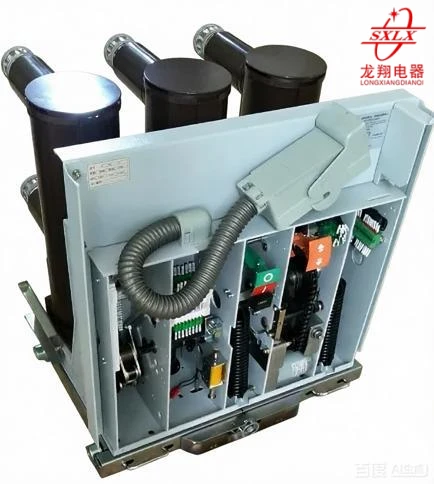
II. Permanent Magnet Operating Mechanism
Working principle
Main components: permanent magnet,excitation coil and moving iron core, generally in two types: single-stable and double-stable:
① Doulbe-stable permanent magnet mechanism (most common)
Closing: The closing coil is energized for a short period of time, generating electromagnetic force to overcome the permanent magnetic attraction, pulling the moving iron core to move towards the closing side, and driving the contact to close; After being in place, the magnetic force of the permanent magnet directly attracts the iron core to maintain the closed position, without the need for mechanical locking.
Opening: Short term reverse current is applied to the opening coil, generating a reverse magnetic field to counteract the permanent magnetic attraction. The moving iron core quickly opens under the action of the opening spring (small spring); After being in place, the other side of the permanent magnet is magnetically attracted to maintain the open position.
② Single-stable permanent magnet mechanism: only the closing is maintained by permanent magnet; The opening relies on the opening spring, and there is no permanent magnet to maintain the opening position.
In short: Closing and opening are achieved by pulse excitation of coils. The position is held by permanent magnet force once in place, eliminating complicated mechanical latches.
Features:
|
Advantages |
Disadvantages |
|
There are very few components, and a large number of latches and locking links have been removed, resulting in a high mechanical lifespan |
Strong dependence on the operating power supply (capacitor energy storage power supply), the coil requires sufficient pulse current; Power failure can affect operation |
|
Less moving parts, low failure rate, and low maintenance workload |
Permanent magnets have demagnetization risks (high temperature, strong reverse magnetic field, long-term aging) |
|
Simple structure, smaller size, crisp movements, and relatively low noise |
The technical threshold is high, and the controller and capacitor drive unit are key; Once the drive circuit is broken, the mechanism cannot operate |
|
Fast response speed, suitable for frequent operation occasions |
The output force is relatively small, mostly used for medium voltage vacuum circuit breakers (mainly 10kV), and less used for large capacity high-voltage circuit breaker |
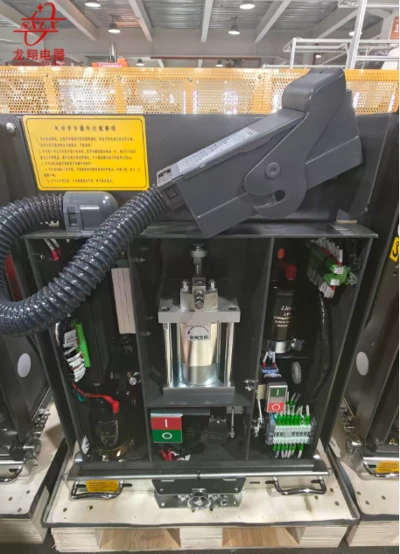
III. Supplementary Comparison
|
Comparison Item |
Spring Operating Mechanism |
Permanent Magnetic Mechanism |
|
Holding Mode |
Mechanical latch (trip pawl) |
Magnetic force of permanent magnet (no mechanical latch) |
|
Energy Storage |
Pre-charged springs, mechanical energy |
No energy storage at standby; coil electromagnetic force at instant of operation, pulse energy supplied by capacitor |
|
Main Components |
Energy storage motor, gears, multiple groups of springs, connecting rods, latches |
Permanent magnet, closing/opening excitation coils, moving iron core, electronic controller, energy storage capacitor |
|
Mechanical Parts |
Large quantity, long transmission chain |
Very few, short transmission chain |
|
Mechanical life |
Typically 10,000 to 20,000 operations |
Up to 100,000 operations or more |
|
Maintenance Requirements |
High; regular lubrication, inspection of latch wear |
Low, nearly maintenance-free |
|
Power Supply Requirement |
Continuous low voltage for energy storage motor; short-time energization of coils |
High reliability requirement for drive power supply / capacitor; dedicated controller required |
|
Application Scenarios |
Large-capacity circuit breakers, switchgears, outdoor circuit breakers; not suitable for frequent operation |
10kV medium-voltage vacuum switchgear, occasions with frequent operations (e.g. capacitor bank switching) |
|
Disadvantages |
Prone to part wear, high impact force, short service life |
Risk of permanent magnet demagnetization, failure upon electronic circuit breakdown, limited output force |
IV. Summary
Spring mechanism: Energy is stored in the spring and locked in the closing position by mechanical buckles. It has many parts, is durable, and requires extensive maintenance.
Permanent magnet mechanism: relying on permanent magnets to hold the iron core in place, without complex mechanical locks, with few components and high lifespan, but relying on electronic drive circuits.