

The moving contact of a vacuum circuit breaker is not a single, fixed shape, and its appearance and internal structure may vary depending on the voltage level, breaking capacity, and specific use.
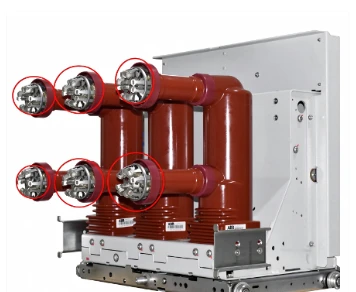
1. Core material: Silver gray alloy block
The front end of the moving contact (i.e. the part that contacts and generates an arc) is usually a cylindrical alloy. The most mainstream material currently is copper chromium alloy (CuCr), which presents a metallic silver gray color. This material has extremely high resistance to arc erosion and good conductivity. In some special or old-fashioned designs, copper tungsten (Cu/W) composite materials may also be used.
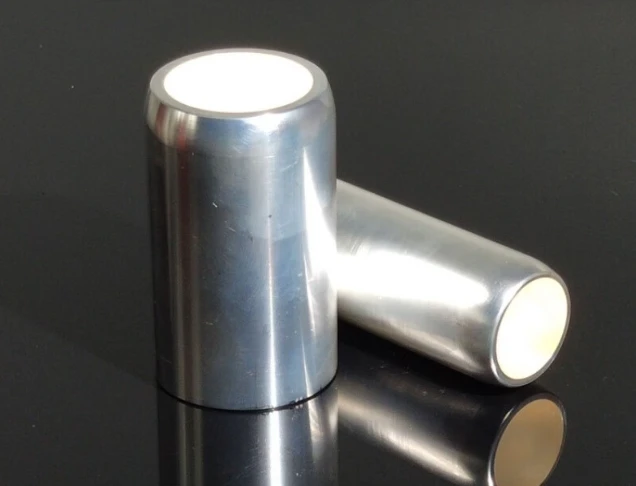
2. Physical shape: Metal disk with special grooves
In order to quickly extinguish the arc in vacuum, the surface of the moving contact is never flat. It is usually designed into shapes with special geometric structures, commonly including:
Spiral groove contact: The surface has a spiral groove, which uses the magnetic field generated by the current to quickly rotate the arc and avoid burning out a certain point.
Longitudinal magnetic field (AMF) contact: The structure is relatively more complex, usually with a cup-shaped or special magnetic conductive structure, which can generate an axial magnetic field and evenly disperse the arc. It is commonly used in high-voltage and high current circuit breakers.
Flat or plum blossom shaped: A relatively simple structure suitable for situations with low loads.
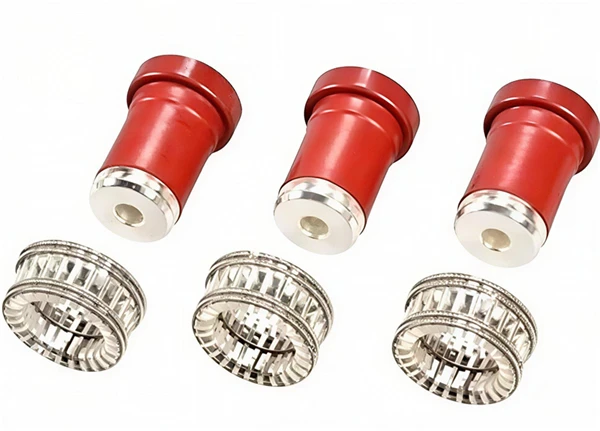
3. Overall component: combination of contact and conductive rod
In the actual vacuum arc extinguishing chamber (vacuum bubble), the "moving contact" we see is actually a whole component:
Contact body: The alloy disc mentioned above is usually welded onto a contact seat or conductive rod made of oxygen free copper.
Heat dissipation and auxiliary structure: In order to dissipate heat, there may be radial heat dissipation holes or circular grooves machined on the conductive rod or contact seat.
Connecting components: The tail of the moving contact is connected to a metal bellows. The bellows can expand and contract like an accordion, ensuring that the moving contacts can move freely for opening and closing, while maintaining a high vacuum sealing state inside.
The core difference between the moving contact and fixed contact lies in "moving" and "fixed".
|
Comparison Item |
Moving Contact |
Fixed Contact |
|
Movement Status |
Movable. Connected to the external operating mechanism and metal bellows, it performs the opening and closing operations. |
Stationary. Rigidly fixed at the other end of the arc extinguishing chamber, serving as a stable current path. |
|
Core Function |
Active actuator. It makes or breaks contact with the fixed contact to switch the circuit on or off. |
Passive counterpart. It provides the mating contact surface for the moving contact and carries incoming or outgoing current. |
|
Wear Level |
Relatively high. Subject to frequent mechanical movement, impact, separation and mechanical stress, it wears faster. |
Relatively low. Free from mechanical friction, yet it still suffers erosion from repeated electric arcs. |
|
Maintenance Requirement |
High priority for inspection. Periodic checks are required for its stroke, wear loss and the sealing performance of the connected bellows. |
Less frequent attention. Only its surface arc erosion needs inspection during overhauls. |
Closing (Energization): The external mechanical assembly pushes the "plug" (moving contact) forward to press firmly against the "socket" (fixed contact). The circuit is closed, and current flows smoothly.
Opening (De-energization): The mechanical assembly pulls the "plug" (moving contact) back rapidly to separate it from the "socket" (fixed contact. An electric arc forms at the moment of separation. However, inside the vacuum environment, the arc extinguishes instantly, safely breaking the circuit.
Moving and fixed contacts are core conductive & arc-extinguishing parts inside vacuum interrupters. Material and structure selection greatly impacts the service life of circuit breakers. Reach out to our technical team for sample support, selection guidance and bulk order inquiries.
Send your equipment model to us if you are looking for replacement contact assemblies, we will match the right solution quickly.