

In the daily work of power distribution, operations and maintenance, and electrical inspection, circuit breakers and disconnectors are the two most common and most easily confused-electrical devices. Many people know that both can "open and close circuits," but few understand that one is a "safety bodyguard" and the other is an "isolation barrier." Their functions, principles, and applications are completely irreplaceable. Today, let's break down the essential differences between the two so you'll never confuse them again!
I. The Core First: Distinguish the Essence in One Sentence
Circuit breaker: A "circuit control core" that can extinguish arcs, break under load, and provide automatic protection.
Disconnector: A "safety isolation device" with no arc-extinguishing capability, operable only under no load, providing a visible break point.
Simply put, the circuit breaker handles "safe power interruption," while the disconnector handles "safe isolation after power is cut." Each performs its own duty-neither can be dispensed with.
II. How a Circuit Breaker Works (Arc Extinguishing, Load Breaking, Protection)
A circuit breaker is designed with one goal: to safely break current under any condition (normal or fault).
1. Contact principle:
(1) Moving and fixed contacts are sealed inside an arc-extinguishing chamber (vacuum, SF₆, oil type, etc.).
(2) An arc is generated during breaking, but the device is specifically designed to extinguish it.
2. Core arc-extinguishing principles:
(1) Vacuum circuit breaker: Uses vacuum insulation; the arc rapidly diffuses and cools to extinction in a vacuum.
(2) SF₆ circuit breaker: Uses the strong arc-extinguishing properties of SF₆ gas to blow out the arc.
(3) Low-voltage circuit breaker: Uses arc chutes to stretch, split, and cool the arc.
3. Protection principle:
Overload / short circuit → abnormal current → trip unit activates → automatic forced breaking
In one sentence, the circuit breaker principle: Arc chamber → permits current-breaking under load → automatically trips on fault → responsible for control and protection.
III. How a Disconnector Works (No Arc Extinguishing, No-Load Switching Only, Isolation Only)
A disconnector has absolutely no arc-extinguishing structure. Its principle is simply mechanical disconnection, forming a visible air gap.
1. Contact principle:
(1) Exposed or simply insulated, no arc-extinguishing chamber.
(2) After opening, forms a visible air break gap to ensure maintenance safety.
2. Operating principle:
(1) Simply mechanically pulls apart / closes the contacts.
(2) Relies entirely on an external circuit breaker to cut the current first; it does not handle arc extinguishing itself.
(3) If operated under load, it will produce an arc that cannot be extinguished → explosion, short circuit.
3. Electrical principle:
(1) Provides only an isolation break point; has no protection, detection, or arc-extinguishing function whatsoever.
(2) Low conduction resistance, but not designed to interrupt current.
In one sentence, the disconnector principle: No arc-extinguishing structure → can only break at zero current → provides only a visible isolation break point → not responsible for breaking load current.
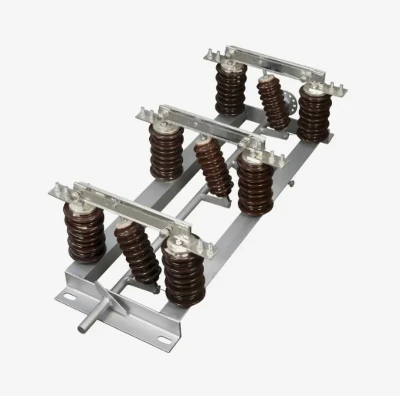
IV. Comparison in Five Key Dimensions
|
Comparison Item |
Circuit Breaker |
Disconnector |
|
Arc-extinguishing capability |
Dedicated arc chamber, actively extinguishes arcs |
No arc-extinguishing structure, cannot extinguish arcs |
|
Breaking capability |
Can break normal load and short-circuit current |
Can only break minimal or zero current |
|
Protection function |
Has trip unit, automatically trips on fault |
No protection, purely mechanical operation |
|
Break point |
Sealed and invisible, judged electrically |
Visible air gap, safe isolation |
|
Core role |
Controls circuits, protects equipment |
Isolates power source, ensures maintenance safety |
V. The Most Critical Point: Operating Sequence Must Never Be Reversed
Power-off operation: Open the circuit breaker first → then pull the disconnector.
Power-on operation: Close the disconnect switch first → then close the circuit breaker.
VI. Final Summary: What's the Real Difference?
The essential difference between a circuit breaker and a disconnector is not appearance or voltage level-it's this: A circuit breaker is a "switch," responsible for cutting current and protecting the system; a disconnector is an "isolation blade," responsible for forming a break point and ensuring personal safety. One handles "electricity," the other handles "safety." Their functions do not overlap, and neither can replace the other.
So please emember this firmly: A disconnector must never be operated under load-the circuit breaker is the current switch.
Whether you need indoor or outdoor disconnectors for your substation and distribution system, we are your trusted supplier of high‑voltage disconnectors. Please reach out to discuss your specifications and get a competitive quote.